
Table of Contents
- Where to Find a Local Scar Revision Specialist
- Scar Revision Versus Plastic Surgery: Understanding Your Options
- What to Expect During a Scar Revision Consultation
- Paramedical Scar Camouflage Benefits and How to Evaluate Providers
- Frequently Asked Questions
Last Updated: August 31, 2026
Where to Find a Local Scar Revision Specialist
Finding a qualified scar revision specialist means knowing where to look and what credentials matter. Start with the American Society of Plastic Surgeons directory, which lets you search by ZIP code. You can also check the American Academy of Dermatology’s provider finder, since dermatologists often handle scar revision alongside plastic surgeons. For patient reviews and real outcomes, RealSelf aggregates before-and-after photos and detailed feedback on specific providers.
Look for board certification from the American Board of Plastic Surgery (ABPS) or the American Board of Dermatology. These credentials mean rigorous training, ongoing education, and accountability to ethical standards, they matter more than years in practice or marketing.
Scar Revision Versus Plastic Surgery: Understanding Your Options
Scar revision is a specific procedure, while plastic surgery is the broader field. Not all plastic surgeons focus on scars, and not all scar revision requires surgery.
Surgical scar revision involves excising the old scar and re-closing the wound with precision techniques like Z-plasty or W-plasty that reorient the scar to blend with natural skin lines. Recovery typically takes 1-2 weeks, though final results improve for months as the new incision heals.
Non-surgical options include laser resurfacing, microneedling, and paramedical scar camouflage. Laser resurfacing removes or remodels scar tissue. Microneedling uses tiny punctures to trigger collagen remodeling. Paramedical scar camouflage uses specialized tattooing to match scar color to surrounding skin. These require multiple sessions spaced weeks apart with minimal downtime.
The choice depends on your scar type, skin tone, budget, and downtime tolerance. Atrophic scars (depressed or pitted) often respond better to surgical excision or aggressive laser work. Hypertrophic or keloid scars may benefit from surgical flattening followed by laser or camouflage. Contracture scars, tight bands that restrict movement, almost always need surgery.
What to Expect During a Scar Revision Consultation
A consultation should feel like a real assessment, not a sales pitch. A qualified provider will examine your scar under good lighting, ask how it formed, assess its impact on function or confidence, and explain what’s actually possible.
Expect the provider to measure and photograph the scar from multiple angles, assess scar depth, color, texture, and movement restriction, ask about your skin healing history and previous treatments, and explain 2-3 realistic options with honest timelines.
A red flag: any provider who guarantees complete scar removal or promises results that sound too good. Honest providers say “we can reduce this by 60-70%” or “this will blend significantly better,” not “it will disappear.”
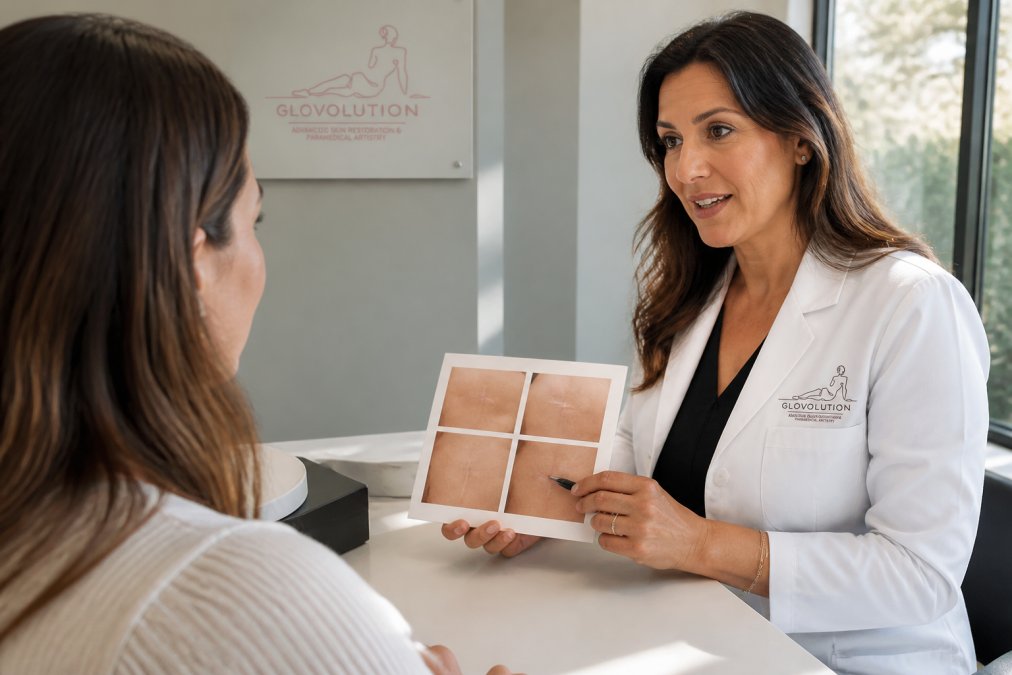
Ask about their specific experience with your scar type and request before-and-after photos of patients with similar scars.
Paramedical Scar Camouflage Benefits and How to Evaluate Providers
Paramedical scar camouflage uses pigment to match scar color to surrounding skin, making the scar visually disappear. It’s permanent or semi-permanent, depending on technique. For flat but discolored scars (pale, red, or hyperpigmented), camouflage can be transformative without surgery.
A certified paramedical tattoo artist uses a tattoo gun or manual hand-tool to deposit pigment into the scar, custom-matching your skin tone in layers. Most scars need 2-4 sessions spaced 6-8 weeks apart.
Benefits include minimal downtime, no anesthesia, and results that improve appearance without changing scar texture. The main limitation: it works best on flat scars with color issues, not raised or depressed scars. Pigment fades over 5-10 years depending on sun exposure and skin type, so touch-ups eventually become necessary.
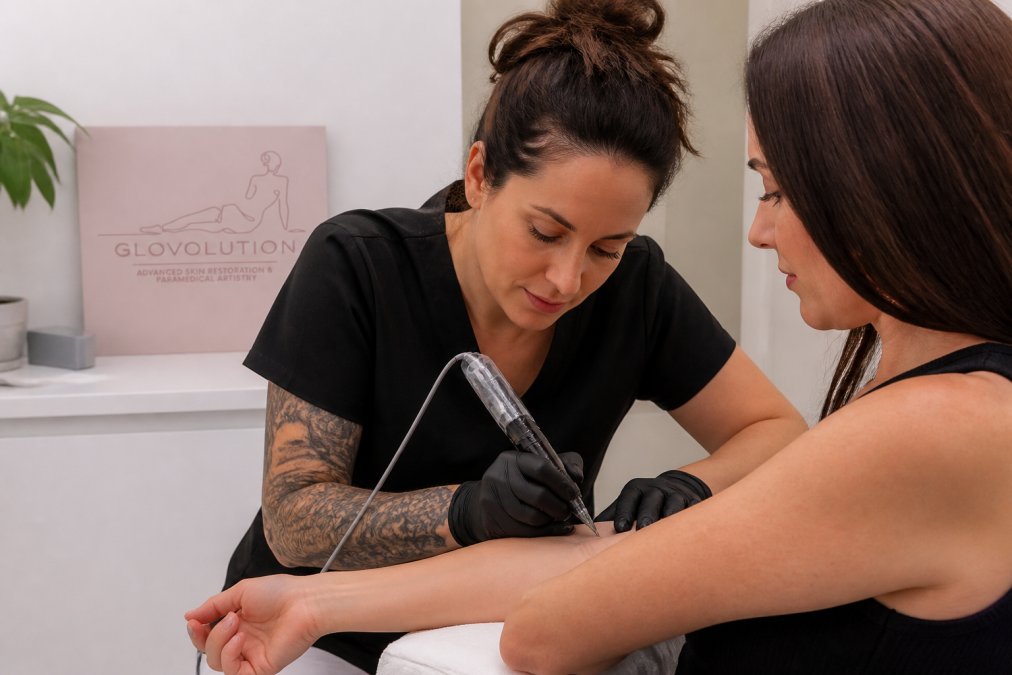
When evaluating a paramedical artist, look for certification in paramedical tattooing, a portfolio showing before-and-afters of scars similar to yours, clear explanation of pigment matching for different skin tones, and honest discussion of fade rates and touch-up frequency.
| Scar Revision Option | Best For | Downtime | Results Timeline |
|---|---|---|---|
| Surgical excision | Depressed or contracture scars | 1-2 weeks | Months for final result |
| Laser resurfacing | Discolored or textured scars | Minimal | 3-6 sessions, weeks apart |
| Microneedling | Atrophic scars, collagen stimulation | Minimal | 4-6 sessions, 4-6 weeks apart |
| Scar Revision & Camouflage | Flat scars with color issues | Minimal | 2-4 sessions, 6-8 weeks apart |
Finding the right scar revision specialist means balancing credentials, experience, and honest communication about what’s possible. Start with official directories, verify board certification, and ask for patient testimonials and before-and-afters matching your scar type. The best outcome comes from a provider who listens to what bothers you most about your scar, appearance, function, or confidence, and tailors a realistic plan. Ready to explore your options? Book an appointment with GloVolution to discuss a personalized scar revision strategy designed for your skin.
Frequently Asked Questions
What kind of doctor performs scar revision?
Scar revision is performed by board-certified plastic surgeons, dermatologists, and dermatologic surgeons. Plastic surgeons handle reconstructive and cosmetic scar work. Dermatologists specialize in skin conditions and offer treatments like laser resurfacing and chemical peels. Certified paramedical tattoo artists provide scar camouflage using tattooing techniques. Your choice depends on scar type, depth, and whether you prefer surgical or non-surgical approaches. A consultation helps determine which specialist is right for your specific scars.
What should I look for when choosing a local scar revision specialist?
Look for board certification from the American Board of Plastic Surgery, American Board of Dermatology, or equivalent credentials. Check before-and-after photos of their scar work. Read patient reviews on platforms like RealSelf and Healthgrades. Verify they have experience with your scar type (keloid, hypertrophic, contracture, or atrophic). Ask about their approach, whether they recommend surgical excision, laser, microneedling, or camouflage. A good specialist will listen to your concerns, explain options honestly, and set realistic expectations about results and recovery.
Will insurance cover scar revision?
Insurance coverage depends on whether the scar is from injury, surgery, or burn and if it causes functional impairment. Scars affecting movement or causing pain may qualify for coverage. Purely cosmetic scar revision is typically not covered. Contact your insurance provider with details about your scar and the recommended treatment. Your specialist’s office can often verify coverage and help with pre-authorization. Some treatment options, like paramedical camouflage, may be out-of-pocket, so discuss costs during your consultation.
This article was written using GrandRanker