
Table of Contents
- What Breast Surgery Scar Revision Before and After Results Really Show
- Surgical Scar Revision vs Paramedical Tattooing
- Breast Scar Healing Timeline and Best Practices for Post-Surgical Scar Care
- Frequently Asked Questions
Last Updated: September 16, 2026
What Breast Surgery Scar Revision Before and After Results Really Show
Breast surgery scar revision before and after results are not a magic eraser, and any clinic selling them that way is selling you a story. Those photos show a scar repositioned, flattened, or faded so it sits more quietly on your skin. This guide from GloVolution walks through what revision can and cannot do, and the real healing timeline.
Scar revision is a set of treatments, surgical or non-surgical, that improve the appearance, texture, and sometimes the discomfort of an existing scar. Fading is gradual, not instant.
If a gallery shows dramatic before-and-after photos with no dates, no healing timeline, and no mention of how many sessions were needed, treat it as marketing, not evidence. Ask when each photo was taken.
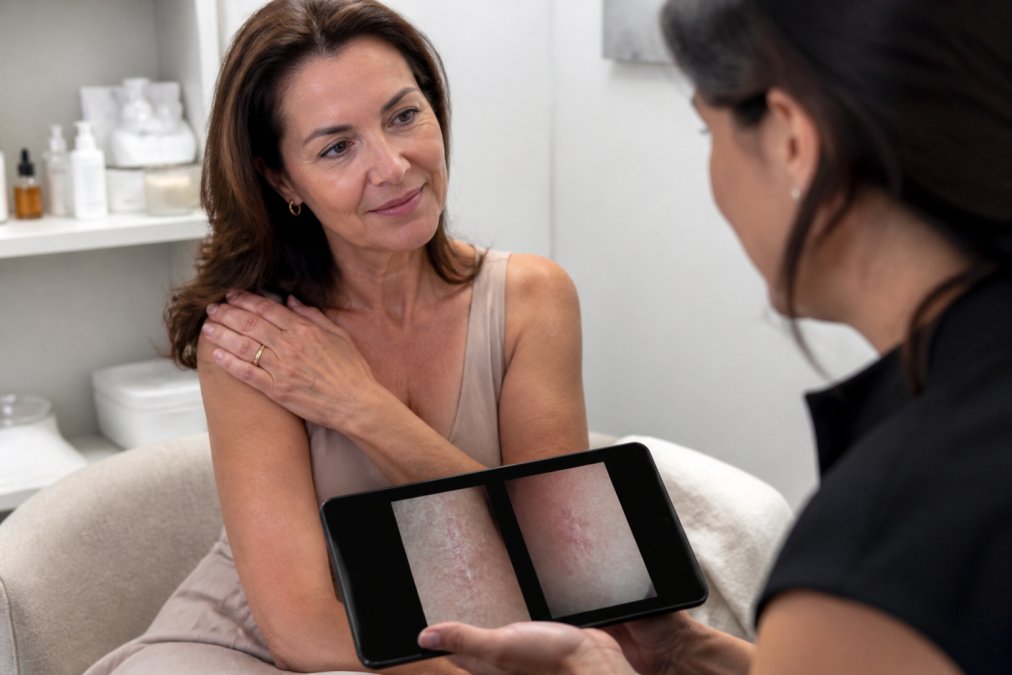
Surgical Scar Revision vs Paramedical Tattooing
Surgical scar revision cuts and re-closes tissue. Paramedical tattooing deposits pigment to blend a scar into surrounding skin. They solve different problems, and choosing wrong wastes your time and money.
Surgical revision suits raised, tethered, or widened scars, but creates a new wound that heals on its own schedule. Paramedical camouflage suits flat, pale, or hypopigmented scars, including areola restoration after mastectomy reconstruction. GloVolution’s Scar Revision & Camouflage work sits in that second category, and the team is upfront that pigment cannot flatten a keloid. For women whose reconstruction left the areola needing color and shape restored, the studio’s 3D Hyperrealism Areola Restoration is built for exactly that.
| Approach | Best For | Downtime | Typical Sessions |
|---|---|---|---|
| Surgical revision | Raised, tethered, widened scars | Days to weeks | One, plus healing |
| Paramedical tattooing | Flat, pale, hypopigmented scars | Minimal | Two to three |
| Silicone sheeting | Early healing incisions | None | Daily wear, weeks |
| Laser resurfacing | Texture and redness | A few days | Several |
Breast Scar Healing Timeline and Best Practices for Post-Surgical Scar Care
Scar maturation takes 12 to 18 months, longer than most expect. Redness fades first, then texture softens, then color settles. What you do in the first six months shapes the result more than anything later.
Common mistakes: judging a scar at three months and panicking, and skipping sun protection, which lets pigmentation darken the scar permanently.
Best practices for post-surgical scar care:
- Keep the incision clean and moisturized per your surgeon’s instructions
- Use silicone gel sheeting or topical silicone once cleared
- Massage gently to support collagen production
- Protect from sun exposure for at least a year
- Avoid tight clothing that rubs the incision
Take your own photos monthly in the same lighting and position. It is the only way to see real progress, because scar fading is too slow to notice day to day.
Frequently Asked Questions
Can you show me pictures of scar revision before and after?
Yes, and you should ask to see them before committing to anything. Paramedical artists like GloVolution share client results during consultation. Look for images taken under similar lighting and from the same angle, and ask how far out from the procedure each photo was taken. Early photos can look worse than final results because scar maturation takes months. A gallery that only shows day-one shots is not telling you the full story.
Do breast surgery scars ever go away?
They fade, but they do not disappear. After breast lift, breast reduction, or mastectomy reconstruction, the incision site goes through wound healing and dermal remodeling for up to a year or longer. Most scars flatten and lighten during that window. Some become hypertrophic or develop keloid formation, which means they stay raised and darker. Surgical revision, silicone gel sheeting, corticosteroid injections, and paramedical tattooing can all improve how a scar looks, but none of them erase it completely. Anyone promising otherwise is overselling.
What is the difference between surgical scar revision and paramedical camouflage?
Surgical revision removes or repositions scar tissue through tissue excision and a new suture technique, which means another incision and another round of post-operative recovery. Paramedical tattooing works on the surface: pigment is matched to your surrounding skin tone to reduce contrast from pigmentation loss or erythema. Surgical revision changes the scar itself; camouflage changes how it reads visually. Many women combine both, using surgery first and camouflage once the revised scar has matured. A consultation will tell you which fits your situation.
Scar revision works best when it is planned, not rushed. If you are weighing surgical revision against paramedical camouflage, GloVolution offers personalized treatment planning, certified paramedical tattoo artistry, and 3D hyperrealism areola restoration, all built around your skin and your timeline. Book an appointment with GloVolution and get a plan grounded in what your scar actually needs.